Belted In 1: Incursion
Player Handout 2: Fortune's Favor -
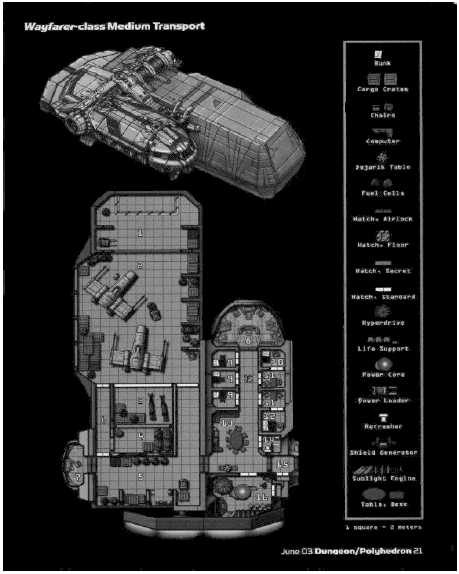
Wayfarer Class Transport
By Christopher West with J.D. Wiker, Illustration
by Jeff Carlisle; Published in Dungeon/Polyhedron may 2003 pp 20-21
The Wayfarer-class medium transport is
constructed with a detachable portside section originally intended for
modular reconfiguration. Kuat Systems Engineering (a now-folded subsidiary
of Kuat Drive Yards) designed the Wayfarer so that it could load a passenger
section, a hangar bay, or cargo module. Production costs forced KSE to
scale back their plans and create only the hangar bay module, which, for
most owners (who generally didn't store fighter craft, anyway), serves
as cargo space. A few prototypes and custom builds of other modules exist,
but are hard to find, limited primarily to bulk commerce corporate shipping
operations centered on welldeveloped metropolitan planets like Coruscant.
The ship's detachable portside half (areas
1-6) fits into an armature extending from the other half (area 7 is connected
to areas 8-16 by this armature). The versatility offered by the detachable
section was initially exciting, until it was revealed that the design could
not accept standard cargo containers. This, combined with a high price
tag, ensured the demise of the ship's production and ultimately the entire
company. Despite the flaws that kept the Wayfarer from becoming a huge
commercial success, the ship's versatility makes it a well-rounded vessel
for any buyer.
Kuat Systems Engineering
Wayfarer-class Medium Transport
Class: Space Transport
Size: Medium-sized (82 meters)
Hyperdrive: x2, x14 backup
Passengers: 6
Cargo Capacity: 220 metric tons
Consumables: 3 months
Cost: 202,500 (new), 130,000 (used)
Crew: 10 (Normal +2)
Initiative: +2 (+2 crew)
Maneuver: +2 (+2 crew)
Defense: 20 (+10 armor)
Shield Points: 60 (DR 15)
Hull Points: 160 (DR 15)
Maximum Speed in Space: Attack (6 squares/action)
Atmospheric Speed: 830 (14 squares/action)
Weapon: Laser cannon; Fire Arc: Front;
Attack Bonus: +4 (+2 fire control, +2 crew); Damage: 4d10x2; Range Modifiers:
PB +4, S +2, M/L n/a.
Weapon: Quad laser cannon; Fire Arc: Left;
Attack Bonus: +4 (+2 fire control, +2 crew); Damage: 6d10x2; Range Modifiers:
PB +4, S +2, M/L n/a.
Compartment Key
-
Forward Cargo Hold. The forward cargo
bold serves as a staging area for loading and unloading. It holds 25 tons
of the ship's cargo capacity when full, but any more than about 10 tons
means that fighter craft in the hangar bay cannot pass.
-
Hangar Bay. Though most owners use
this compartment as a cargo hold, it is outfitted as a miniature hangar
bay capable of carrying two Tiny ships comfortably. When not used as hangar
space, it holds 160 tons of cargo. Each Tiny ship kept here reduces that
total by 40 tons.
-
Speeder Pool. This is another case
of a compartment generally used for something other than the intended design.
The speeder pool can comfortably store two Large vehicles (or five speeder
bikes) and one other Large vehicle if the ceiling clamps are employed,
Otherwise, this area accounts for 15 tons of storage space.
-
Secret Cargo Hold. This 5-ton storage
hold wasn't originally designed as a secret compartment, but the hatches
are so easily disguised as blank bulkhead that it seems like the designers
had that purpose in mind all along.
-
Aft Cargo Hold.
The aft cargo hold can store up to 25 tons, but that leaves precious little
room for anyone to move through the compartment without crawling (Escape
Artist check, DC 10).
-
Portside Corridor. The portside corridor
is meant to provide easy access to the hangar bay when the aft cargo hold
is completely full. It is jokingly referred to as "Lover's Lane," because
it is so isolated.
-
Gunnery Station. When the hangar bay
is detached, a crewman inside the gunnery station can also detach the station,
allowing it to be maneuvered by small directional jets into position on
the main hull on the module docking clamps. It also serves as a three-person
escape pod (one seated, two in crash webbing), and has enough power to
keep passengers alive for up to 12 hours -- or about enough power to fire
the attached quad laser once.
-
Bridge. The six-station bridge can
be crewed by one person for short periods. It also controls the main gun,
a laser cannon fixed in position atop the hull.
-
Crew Cabins. Each crew cabin has sleeping
space for two crewmembers, with separate lockers for up to three crewmembers.
-
First Mate's Cabin. Can serve as a
temporary passenger cabin.
-
Offices. Includes a desk and two chairs.
-
Captain's Cabin. Can serve as a temporary
passenger cabin.
-
Crew Lounge. The spacious crew lounge
includes the galley and a conference table, along with a nominal entertainment
center.
-
Refresher. Cabinets here hold first
aid supplies.
-
Airlock. The starboard airlock includes
a small storage compartment containing three environmental suits.
-
Drive Chamber. The drive chamber includes
a small closet for storing two environmental suits and a tool chest.